The root cause of survey failure is the inability or difficulty to execute effective change. Note the word "effective" for those ready to pounce.
When data results of large groups are calculated by averages, barriers to change efforts increase by multiples. Contrasted, with an ability to see survey results idvidually by pockets of groups within that large group, targeted change for that small group become an instant capability for the change agent.
To see a CAT scan picture of each organizational 'body part', the task of the consultant/client becomes easily manageable. Departments by each manager now become an individual action plan based on what's critical and discovered to that department - the impact is rapid and dramatic. Once each manager can see how their behaviors, values and style impacts their workgroup, change potential is instant. Adding a one-on-one coaching initiative produces even more effective transformational results for that manager and that workgroup. Internally trained experts keep the cost of implementation to virtually zero, an internal talent management team is being groomed, and accountability and sustainability is a by product. The change continues long after the survey consultants leave.
Friday, May 20, 2011


Wednesday, May 18, 2011
Certified Survey Consultant in Action
An update from one of our newest Certified Survey Consultants and Licensee of the Infotool Software:
Michael J. Stabile, PhD - CEO of FutureNow Consulting (http://www.futurenowed.com/):
"Just wanted you to know that since we left the training last Wednesday, we have used the training and tools in some fashion or form. On Thursday, I helped our statistics director at Xavier University with our demographic results from the Servant Leadership study for an accreditation review. On Friday, I worked with a high school team at St. Xavier High School and because of our ability to dig deeply into the data, within five minutes was able to help them change directions that would have been toxic for the school culture using the horizontal and vertical alignment visual (modified for education). On Monday, I presented the data results and analysis of St. Xavier High School's DNA of Culture Survey to about 40 of their staff members to position their school culture with specific and target areas to address. Yesterday, Tuesday, I did a presentation for Viox Facilities Management, a business leadership-training group, on their 2011 DNA of Culture results in comparison to their 2010 results and titled the presentation as The Power of Alignment. As part of the training exercise, after I presented the data results, we broke into 6 groups of 3 and each group had to draw conclusions from the data results including the Predictive Matrix measure diagrams, practical applications, and next steps. There was an amazing agreement in and among the groups. Then I showed them my findings, conclusions, and suggested practical next steps. Not only were we aligned, they own the data results. "If you can find it, you can fix it." This coming Friday, I am work with another school on a strategic planning process and I am going to include The Power of Alignment Model with a suggested survey analysis."
Michael J. Stabile, PhD - CEO of FutureNow Consulting (http://www.futurenowed.com/):
"Just wanted you to know that since we left the training last Wednesday, we have used the training and tools in some fashion or form. On Thursday, I helped our statistics director at Xavier University with our demographic results from the Servant Leadership study for an accreditation review. On Friday, I worked with a high school team at St. Xavier High School and because of our ability to dig deeply into the data, within five minutes was able to help them change directions that would have been toxic for the school culture using the horizontal and vertical alignment visual (modified for education). On Monday, I presented the data results and analysis of St. Xavier High School's DNA of Culture Survey to about 40 of their staff members to position their school culture with specific and target areas to address. Yesterday, Tuesday, I did a presentation for Viox Facilities Management, a business leadership-training group, on their 2011 DNA of Culture results in comparison to their 2010 results and titled the presentation as The Power of Alignment. As part of the training exercise, after I presented the data results, we broke into 6 groups of 3 and each group had to draw conclusions from the data results including the Predictive Matrix measure diagrams, practical applications, and next steps. There was an amazing agreement in and among the groups. Then I showed them my findings, conclusions, and suggested practical next steps. Not only were we aligned, they own the data results. "If you can find it, you can fix it." This coming Friday, I am work with another school on a strategic planning process and I am going to include The Power of Alignment Model with a suggested survey analysis."

Tuesday, May 17, 2011
New Power of Survey Diagnostics
Information analysis is the new "holy grail" in our work. In the implementation phase of your work, it's becomes your key capability, as advisers, to "fix what we can discover is broken" through the prioritization of those actions most correlated to the Vision work. This is the new power of survey diagnostics.
This discover phase traditionally is the core of an advisers work product. Imagine how long we will remain "on the job" if we elect to take actions on the wrong critical success factors-the ones with the lowest ROI. You may have more billable hours, but I doubt the company will hire you back.
Surveys have morphed into diagnostic instruments that can aid consultants in their analysis work. No matter which diagnostic you select, its like using a CAT scan machine as a physician does before proscribing; but now consultants have them. Converts say its the newest frontier that can help their clients blueprint the way to rapidly realign organizations in their quest for value creation.
In your next project, try using one of the diagnostic tool for data collection/analysis to see how these new powers will help your effectiveness and value to your client. try to avoid the off the shelf, low budget data collection/analysis system that provides average results, have funny names and provide little advisory/analysis support.
This discover phase traditionally is the core of an advisers work product. Imagine how long we will remain "on the job" if we elect to take actions on the wrong critical success factors-the ones with the lowest ROI. You may have more billable hours, but I doubt the company will hire you back.
Surveys have morphed into diagnostic instruments that can aid consultants in their analysis work. No matter which diagnostic you select, its like using a CAT scan machine as a physician does before proscribing; but now consultants have them. Converts say its the newest frontier that can help their clients blueprint the way to rapidly realign organizations in their quest for value creation.
In your next project, try using one of the diagnostic tool for data collection/analysis to see how these new powers will help your effectiveness and value to your client. try to avoid the off the shelf, low budget data collection/analysis system that provides average results, have funny names and provide little advisory/analysis support.
Monday, May 16, 2011
Elevating HR to the Boardroom
HR involvement in understanding and guiding the employee to productivity and engagement is a gift that CEO's would treasure, but HR must first get to a higher level of capability. This higher level of capability means having evidence-based information. There will need to be a proving process to be first demonstrated before HR is invited into the boardroom.
As Deming quoted: " Its not enough to do your best; you must know what to do and then do your best."
My humble opinion is that for HR, as an industry, to gain such acceptance in leadership circles, they must use tools and technology to elevate and gain credible intelligence about employee drivers; then skills to use those tools to impact positive change. New technology is available in the marketplace to support HR and old paradigms need be discarded.
So, the burden lies on HR to elevate itself into the boardroom. Let's say it's a prejudice that will be hard to overcome, but can be only by the most "engaged" HR folks.
As Deming quoted: " Its not enough to do your best; you must know what to do and then do your best."
My humble opinion is that for HR, as an industry, to gain such acceptance in leadership circles, they must use tools and technology to elevate and gain credible intelligence about employee drivers; then skills to use those tools to impact positive change. New technology is available in the marketplace to support HR and old paradigms need be discarded.
So, the burden lies on HR to elevate itself into the boardroom. Let's say it's a prejudice that will be hard to overcome, but can be only by the most "engaged" HR folks.
Tuesday, April 19, 2011
SHRM Q&A
1. What specific steps can leaders take to move employees from disengagement to engagement?
Senior Leadership-Very little..Role is vision and set tone for culture
Managers- A great deal. Role is to manage the engagement levels. To know, understand and address the key drivers of motivation. To then connect the engaged worker to the “business of the business”, to include culture, process, training, and customer requirements
2. HR leaders can enhance their strategic contribution by having a greater understanding of the CEO’s point of view. What, according to you, are the things that your CEO will never tell you but HR needs to know?
HR needs to know what’s required of them to make the “business of the business” work according to the vision and projections. What tools, skills and training does the workforce need to meet the customers’ demands?
HR also needs to know what the CEO knows about the customer loyalty strategy. Many times the CEO doesn’t know, especially if the business strategy is correlated to the known customers buying needs and habits
3. A recent study of human resources and leadership development executives, conducted by the Wall Street Journal, showed that the #1 most sought after executive skill is strategic thinking. Unfortunately, 90% of directors and vice presidents have never had any education in strategic thinking. How can HR practitioners master this discipline?
Strategic thinking if correlated to customers sets the core. HR must be involved in the customer satisfaction surveys, be linked to customer service. This is the #1 strategic visioning.. The rest are tactics on execution of that customer strategy.
Can HR master the discipline? Not as long as leadership and HR are not at the same table, and that HR has not mastered an understanding of the business concepts of alignment. HR must expand their span of understanding of business principles. If not, HR will always be considered as just having a benefits analysis function.
4. While HR training can actually improve the business bottom line, organizations often fumble with the knowledge and understanding of establishing expectations and auditing procedures to drive measurable results throughout the organization. How can organizations get it right?
HR training means what? HR is trained or the workforce is being trained.
To get it right, training must be associated with the “business of the business”. Training needs to be targeted to the party that needs to modify their behaviours or improve their skills in their job description.
The expensive, global “all inclusive” training sessions have not produced a desired ROI return
Hence, you start with an employee engagement survey customized for the “business of the business”. Knowledge of need, by work group, is the key. Measure drivers of engagement as well as business/process/culture/manager functions. IT MUST BE CUSTOMIZED to have attachment to a change process.
5. Could you please highlight key steps necessary to sustain an engaged culture, improve business results and maintain credibility with employees while reinforcing that success involves the “mutual commitment” of both the leadership and employees?
1. Understand and measure the key drivers of the people, correlated to the business, using a customized employee engagement diagnostic with extensive demographics, measuring
a. Engagement of people
b. Customer focused links
c. Culture
d. Process
e. Strategy knowledge
f. Manager and leaders competencies
2. Leadership crystallize the business objectives for the population
3. Make certain the next level of leadership are aligned with each other; then if it’s deployed vertically downward. This is Line Of Sight and the essence of strategy deployment
4. Each manager now becomes the bearer of the “torch”. From the diagnostic, mentoring-coaching each manager to behave better, align the department to the vision and execute the “business of the business” becomes the key to rapid transformation, accountability and sustained results. This is the value chain and service profit chain. It’s the place where customer loyalty begins and ends.
5. To have sustain results, certified, internal experts will continue to work with managers long after the experts leave, using the diagnostic results
6. Please outline the blueprint to leading organizational change in a way that increases employee engagement, and at the same time, improves morale, productivity and retention?
See above
7. Having attended the SHRM Annual Conference in 2010, how do you think professional development conferences and certification contribute to employee engagement and development? In your view, what impact do these have on an employee’s personal and professional advancement?
Competent certified internal consultants can bring organizations to the highest stare of readiness for change. The certification is a speciality centered on building an employee engagement culture, aligned to “the business of the business”. Without it, sustained change will most likely not be achieved. Habit is the most difficult behaviour to change as all behaviours and the actions we take in a stimuli return to a familiar mold without outside intervention. This certification needs to boarder on organizational development consulting training-not off the shelf typical materials.
Senior Leadership-Very little..Role is vision and set tone for culture
Managers- A great deal. Role is to manage the engagement levels. To know, understand and address the key drivers of motivation. To then connect the engaged worker to the “business of the business”, to include culture, process, training, and customer requirements
2. HR leaders can enhance their strategic contribution by having a greater understanding of the CEO’s point of view. What, according to you, are the things that your CEO will never tell you but HR needs to know?
HR needs to know what’s required of them to make the “business of the business” work according to the vision and projections. What tools, skills and training does the workforce need to meet the customers’ demands?
HR also needs to know what the CEO knows about the customer loyalty strategy. Many times the CEO doesn’t know, especially if the business strategy is correlated to the known customers buying needs and habits
3. A recent study of human resources and leadership development executives, conducted by the Wall Street Journal, showed that the #1 most sought after executive skill is strategic thinking. Unfortunately, 90% of directors and vice presidents have never had any education in strategic thinking. How can HR practitioners master this discipline?
Strategic thinking if correlated to customers sets the core. HR must be involved in the customer satisfaction surveys, be linked to customer service. This is the #1 strategic visioning.. The rest are tactics on execution of that customer strategy.
Can HR master the discipline? Not as long as leadership and HR are not at the same table, and that HR has not mastered an understanding of the business concepts of alignment. HR must expand their span of understanding of business principles. If not, HR will always be considered as just having a benefits analysis function.
4. While HR training can actually improve the business bottom line, organizations often fumble with the knowledge and understanding of establishing expectations and auditing procedures to drive measurable results throughout the organization. How can organizations get it right?
HR training means what? HR is trained or the workforce is being trained.
To get it right, training must be associated with the “business of the business”. Training needs to be targeted to the party that needs to modify their behaviours or improve their skills in their job description.
The expensive, global “all inclusive” training sessions have not produced a desired ROI return
Hence, you start with an employee engagement survey customized for the “business of the business”. Knowledge of need, by work group, is the key. Measure drivers of engagement as well as business/process/culture/manager functions. IT MUST BE CUSTOMIZED to have attachment to a change process.
5. Could you please highlight key steps necessary to sustain an engaged culture, improve business results and maintain credibility with employees while reinforcing that success involves the “mutual commitment” of both the leadership and employees?
1. Understand and measure the key drivers of the people, correlated to the business, using a customized employee engagement diagnostic with extensive demographics, measuring
a. Engagement of people
b. Customer focused links
c. Culture
d. Process
e. Strategy knowledge
f. Manager and leaders competencies
2. Leadership crystallize the business objectives for the population
3. Make certain the next level of leadership are aligned with each other; then if it’s deployed vertically downward. This is Line Of Sight and the essence of strategy deployment
4. Each manager now becomes the bearer of the “torch”. From the diagnostic, mentoring-coaching each manager to behave better, align the department to the vision and execute the “business of the business” becomes the key to rapid transformation, accountability and sustained results. This is the value chain and service profit chain. It’s the place where customer loyalty begins and ends.
5. To have sustain results, certified, internal experts will continue to work with managers long after the experts leave, using the diagnostic results
6. Please outline the blueprint to leading organizational change in a way that increases employee engagement, and at the same time, improves morale, productivity and retention?
See above
7. Having attended the SHRM Annual Conference in 2010, how do you think professional development conferences and certification contribute to employee engagement and development? In your view, what impact do these have on an employee’s personal and professional advancement?
Competent certified internal consultants can bring organizations to the highest stare of readiness for change. The certification is a speciality centered on building an employee engagement culture, aligned to “the business of the business”. Without it, sustained change will most likely not be achieved. Habit is the most difficult behaviour to change as all behaviours and the actions we take in a stimuli return to a familiar mold without outside intervention. This certification needs to boarder on organizational development consulting training-not off the shelf typical materials.
Thursday, April 7, 2011
Question from an HR Professional
An HR Professional asked me:
"Employees have been dis-engaged for sometime now. There have been changes in management to deal with some of the issues which created an environment which facilitated the dis-engagement of the employees. An assessment of the interventions which accompanied the changes in management have not shown that the re-engagement process has successfully commenced. How would you suggest that we now proceed?"
Much similar to the thought process of my last blog post, I wanted to share with you my response:
"In my experience, worker engagement is a state of mind, much like an energy source stored in a battery. A weak charge, when connected to a conduit of the "business of the business" will impact the entire enterprise, including customer delivery. Of course the converse is also true with a fully charged battery.
The key is to find the source of the "weak charge" and fix it...and fast! This starts with information. It can be anywhere...
Information by each demographic needs to include existing culture, managerial style, processes, training needs, communication and trust, a “we” vs. “I” culture, requirements to meet customer needs, manager competency and other alignment measures. The need to slice the information by each demographic group is critical to implementation success; without it, “change” accountability cannot be imposed on those to be held responsible.
This is not a one-on-one effort. There is a huge sense of urgency to get your people engaged as it goes to the essence of the business success"
"Employees have been dis-engaged for sometime now. There have been changes in management to deal with some of the issues which created an environment which facilitated the dis-engagement of the employees. An assessment of the interventions which accompanied the changes in management have not shown that the re-engagement process has successfully commenced. How would you suggest that we now proceed?"
Much similar to the thought process of my last blog post, I wanted to share with you my response:
"In my experience, worker engagement is a state of mind, much like an energy source stored in a battery. A weak charge, when connected to a conduit of the "business of the business" will impact the entire enterprise, including customer delivery. Of course the converse is also true with a fully charged battery.
The key is to find the source of the "weak charge" and fix it...and fast! This starts with information. It can be anywhere...
Information by each demographic needs to include existing culture, managerial style, processes, training needs, communication and trust, a “we” vs. “I” culture, requirements to meet customer needs, manager competency and other alignment measures. The need to slice the information by each demographic group is critical to implementation success; without it, “change” accountability cannot be imposed on those to be held responsible.
This is not a one-on-one effort. There is a huge sense of urgency to get your people engaged as it goes to the essence of the business success"
Tuesday, April 5, 2011
An Employee Engagement State of Mind
Employee Engagement is just a state of mind and as such is very hard to define, but easy to describe. Think of it as energy stored in a battery awaiting to be plugged into action or to conduit for the energy to ignite positive action.
With Employee Engagement, two concepts must be considered:
1. The drivers, both emotional and rational, of the workforce (EE) and get a way to identify and address the EE issues with each group individually.
2. A means to ensure that when the energy is discharged, it's connected to good, solid business principals and processes, led by a strong leader or Director.
As to #1, any person dealing in trying to bolster EE is doomed to failure unless:
1. You first acquire information as to the cause of the barriers by workgroup
2. Where the barriers are being formed (high, middle or managerial level)
3. A means to identify the "root barriers" by each department/workgroup.
4. recognize that different work groups have different barriers, caused by different things
5. Recognize that the most rapid and global enterprise solutions will be created by the managers (provided they are not toxic as well)
6. A means to give each manager the skills, tools, information and support to dissolvie the barriers . You can't hold anyone accountable to "change" unless you give them the tools to do so. Accountability is the only tool that creates sustained results, especially if know they will be remeasured in 6-8 months.
7. Just because workers are "happy" doesn't make them engaged, so "engaged in what" leads me to point #2
8. The business strategies must be aligned with the effort of engaging the departmental worker, sa managers need information as to what, how and why they need to link the department initiatives to the "main thing" business strategies.
SUMMARY: Engaging a workforce consists of an integrated series of scenes in in a play, all directed by a committed, vocal CEO.
With Employee Engagement, two concepts must be considered:
1. The drivers, both emotional and rational, of the workforce (EE) and get a way to identify and address the EE issues with each group individually.
2. A means to ensure that when the energy is discharged, it's connected to good, solid business principals and processes, led by a strong leader or Director.
As to #1, any person dealing in trying to bolster EE is doomed to failure unless:
1. You first acquire information as to the cause of the barriers by workgroup
2. Where the barriers are being formed (high, middle or managerial level)
3. A means to identify the "root barriers" by each department/workgroup.
4. recognize that different work groups have different barriers, caused by different things
5. Recognize that the most rapid and global enterprise solutions will be created by the managers (provided they are not toxic as well)
6. A means to give each manager the skills, tools, information and support to dissolvie the barriers . You can't hold anyone accountable to "change" unless you give them the tools to do so. Accountability is the only tool that creates sustained results, especially if know they will be remeasured in 6-8 months.
7. Just because workers are "happy" doesn't make them engaged, so "engaged in what" leads me to point #2
8. The business strategies must be aligned with the effort of engaging the departmental worker, sa managers need information as to what, how and why they need to link the department initiatives to the "main thing" business strategies.
SUMMARY: Engaging a workforce consists of an integrated series of scenes in in a play, all directed by a committed, vocal CEO.
Wednesday, March 23, 2011
High Performance Engagement
The HPE (High Performance Employee Engagement Survey Instrument) has been designed using the highest standards of researched and organizational change management concepts. It's long standing that alignment of the workforce to the customer, strategies, leadership and the enterprise is the ideal in maximizing business performance.
The latest research in engagement validates what we already know; that the essence for transformation lies in the hearts, soul and minds of employees. Learning how to get people "engaged" is the foundation for change and any effort to move mountains without the support and participation of the workforce is deemed for possible failure. We've developed a High Performance Engagement tool and for our engagement measures, we selected the research of the Canadian Conference Board, as it represents the most advanced insight in people motivators.To that end, High Performance Engagement measures three separate components: Rational Engagement Drivers (measuring retention components), Emotional Engagement Drivers (measuring whether the workers will give that extra discretionary effort to do what needs to be done) and thirdly, Operational Excellence Measures. The last is a customized approach to learning what are the barriers currently existing that prevent easily achieving the leaders stretch goals, or the vision, and to learn why these barriers exist. "Survey Intelligence" means that survey design is built for targeting unique solutions for the client. It's not an off the shelf tool whose value only lies in being able to compare your scores to others without any actionable consequences. The former translates to action, while the latter translates to learning what happened yesterday.
Customization of surveys means accountability. The ability for each workgroup manager to know exactly what they need to do in terms of engaging their employees to perform better, committed and more effectively for the benefit of the organization. It's the path for the workforce to be able to engage themselves in the "business of the business". Profitability or specific outcomes are the reward.
The HPE has been tested and proven to produce the statistics, outcomes, graphics, core relations between leaders and worker, and SWOT to provide the tools for each manager to be able to transform their workgroup into a strong "link in the value chain".
POWERFUL DIAGNOSTICS:
Great data results can only be translated by using a powerful diagnostic tool that allows unlimited analysis capability, right down to each department or demographic level. Each manager gets an x-ray of their department measuring the engagement levels of their work unit, along with a clear picture as to their need requirements the team needs to contribute to the "business of the business", instant action ability for "continuous improvement," become the norm, Each manager will have the ability to know exactly what they need to do, how to modify their actions, behaviors, values, habits processes to motivate a new dynamic workforce aligned to the corporate goals. (the Operational Excellence Measures). Multiply that power by each department, you have the means for rapid realignment for the best interest of the entire organization.
SurveyTelligence's powerful diagnostics are the key. They provide the ability to look below all averages, by each and every workgroup. Built in correlation analysis tool instantly identify and prioritize the specific actions steps for key, predefined drivers, cross tab, gap, SWOT, comparative, aggregation, histogram analysis are all included. This online powerful diagnostic tool sorts billions of data bytes into action steps for each manager and leaders. Its instant, virtual, and produces the most powerful, easy-to-use, graphics for change.
IMPLEMENTATION:
Change management happens when engaged employees are committed in heart, mind, body and soul to take that extra step in "giving all for the gipper". This level of commitment is found in football players, firefighters, Coast Guard personnel, Marines, etc , but seldom in the private sector. In fact in the private sector, their workers' expectations, drivers, motivators and commitment levels are entirely motivated by different expectations. The difference is clear. In the former, leadership is controlled and mandated; in the latter, it needs to be earned, usually from the most immediate supervisor.
Top leadership's role is to dictate the vision; the managers is to execute the business of the vision. Using the analytics of SurveyTelligence and its slicing capability, each manager of each department will have their own picture of the culture of their department, with the action steps to better engage their employees. This is the only effective means to align the people with the enterprise goals. Education, mentoring and coaching is a critical component.
A Train-the-trainer initiative is a rapid, inexpensive way to build an internal competency that will engage and align managers, which effort will endure long after the high priced survey consultants leave. With building an internal professional coaching staff, the ongoing mentoring creates an “accountability" by the managers. They soon know that this transformation is not "another flavor of the month". Senior management is quite serious and sustainability of expectation of change will be re measured.
Thursday, March 10, 2011
SurveyTelligence Training Session Feedback
Last month Infotool Inc. held our very first SurveyTelligence Training Session where three prominent business consultants spent two and a half days learning and becoming certified in "Survey Intelligence".
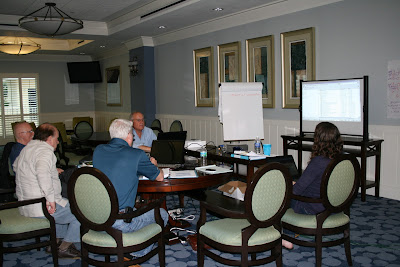
The term "Survey Intelligence" includes organizational assessment building methodologies backed by academics and research linked to achieving organizational goals, data analysis, navigation of Infotool's reporting tools and presentation techniques to really "wow" a client. The participants worked together to present a case study to a Senior VP of a Bank. At the close of the session, each consultant received a plaque certifying each as a "Certified Survey Consultant".
We are excited to share with you some pictures from our session and feedback from our Certified Business Survey Consultants.

 |
"The SurveyTelligence certification workshop was a most beneficial experience. Now in our management consulting practice, geared at improving holistic enterprise competitiveness, we have the right tool to discover key opportunities for aligning any organization and thus deal more effectively with all levels of resistance to change. SurveyTelligence also builds on inherent simplicity and a powerful statistical engine to dissect the critical information from the haystack of data in just seconds, presented with most impressive and useful graphics so management can focus on the important leverage points for organizational changes. Having SurveyTelligence will definitely facilitate dealing with resistance for change as we implement organizational and processes improvements for our clients." -Michael Bolanos Davis ,SurveyTelligence Ecuador, February 20, 2011 |
 |
"I attended the SurveyTelligence workshop expecting to learn about how I could implement a simple survey tool within my existing consulting practice. I came away from the session with a new vision for what my practice could, should and will be. That vision is now powered by the incredible diagnostic capabilities of InfoTool. It's one that will allow me to help my clients align their corporate strategy with the feet in the street as well as with their internal process and their clients. To experience the power of this program for the first time is to understand that the sky is the limit." -Bob Woodcock, The Pulse Check, Canada, February 19, 2011 |
 "To learn from the likes of Stan and George Labovitz was an awesome experience. To learn about the incredible power of the InfoTool diagnostics that Stan developed. To learn how this information will provide powerful survey intelligence about a client’s people and the needs of their organization was incredible. Then to learn how to use that data to help them with that intelligence to propel their organization into a stronger, better, more capable group working together to be more engaged, more aligned with a goal of being more profitable/successful. A stronger strategically sound team will be the end result. It was a great seminar that I am only so glad I took the opportunity to become part of. " |
| - Bob Jacobson, Jacobson Solutions, US, March 23, 2011 |
For more information on our next Certified Survey Business Consulting Course, contact us at info@infotool-online.com or call us at 1(866)616-5552
Subscribe to:
Posts (Atom)
